The Anatomy of an Addictive Microdrama
5 Ingredients Every Creator Needs to Know
By microdra.ma · Vertical Future
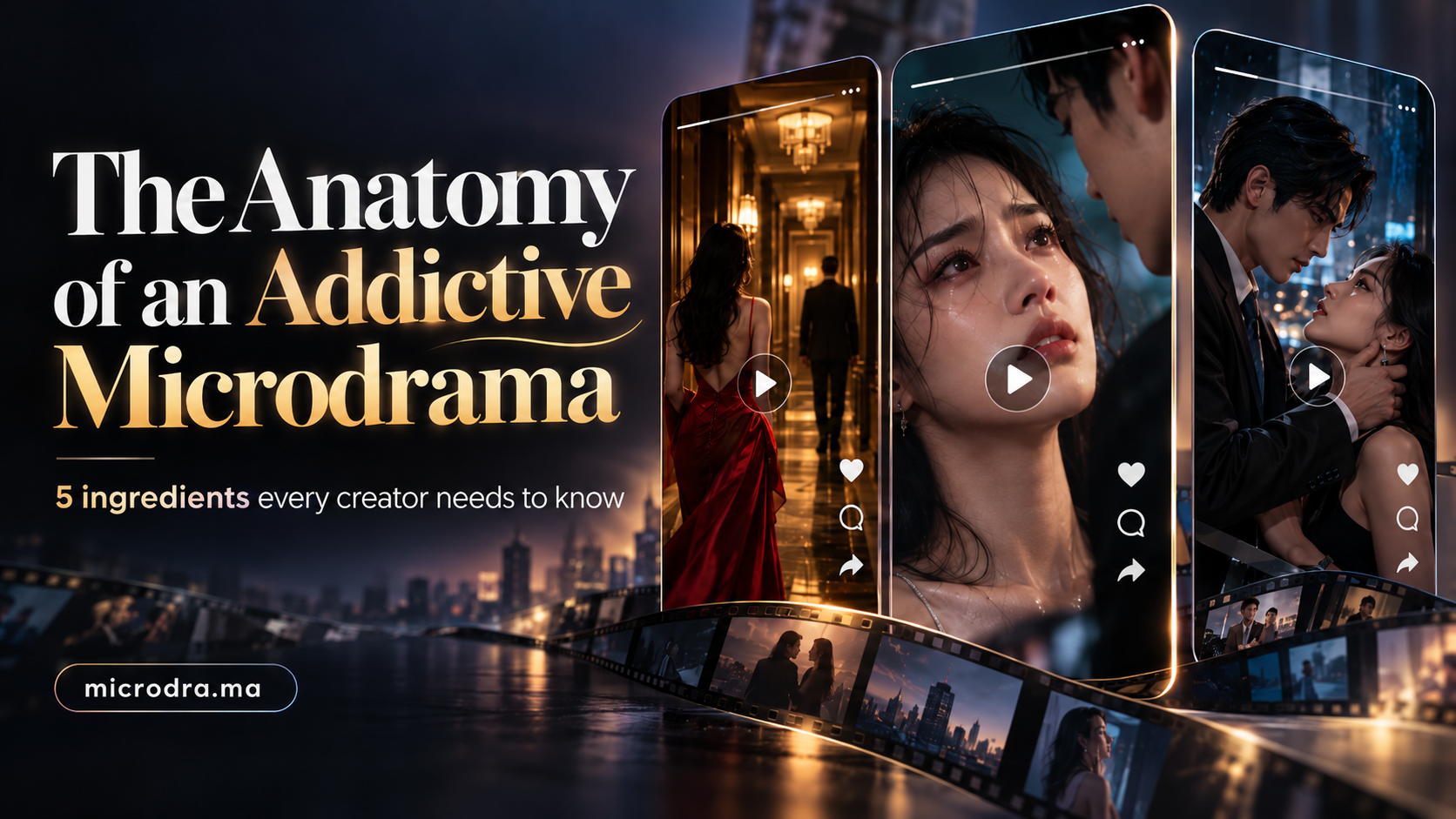
You can create an entire series with AI. But can you create one that audiences can't stop watching?
Not long ago, producing a television series required a production company, a substantial budget, a cast, locations, crews, and months of work.
Today, a single creator with a laptop and the right AI tools can bring an entire fictional universe to life.
But there's a catch.
AI has made it easier than ever to produce video. It hasn't made it easier to tell a great story.
We've all seen incredible AI-generated visuals: futuristic cities, stunning characters, cinematic landscapes, impossible camera movements. They look amazing. We watch, we admire, and then we scroll.
A great microdrama does something different.
It makes us need to know what happens next.
And that's the difference between creating a cool AI video and creating a series with real potential.
At microdra.ma, we're interested in stories that can grow beyond a single video: stories with audiences, memorable characters, commercial opportunities, and the potential to develop into valuable original IP.
So what actually makes a microdrama work?
Let's break it down.
First, Understand the Difference Between a Video and a Series
Imagine you've created a spectacular 60-second video about a mysterious woman walking through a futuristic hotel.
The lighting is beautiful. The soundtrack is perfect. The visual effects are extraordinary.
But what happens next?
Who is this woman? What does she want? What's standing in her way? Why should we care?
And most importantly, why would anyone come back for episode two?
A video can survive on aesthetics.
A series needs a storytelling engine.
It needs something that can generate conflict, surprises, emotional investment, and new episodes without running out of steam.
That engine starts with five fundamental ingredients.
1. The World: Give Your Story a Universe Worth Entering
Every memorable series exists in a distinctive world.
It doesn't have to be fantasy or science fiction. A world can be completely realistic.
Think of a luxury hotel, a high-pressure restaurant kitchen, a fashion empire, a professional football club, a suburban neighborhood, or a chaotic newsroom.
The key is that the world should have its own recognizable environment, rules, rituals, and possibilities for conflict.
Imagine a microdrama set in a luxury hotel.
You have guests, staff, secret relationships, VIP suites, extravagant parties, hidden corridors, and people who aren't necessarily who they claim to be.
Now imagine the same basic story set inside a professional sports team.
Suddenly, you have locker rooms, rivalries, contracts, injuries, competitions, and betrayal.
The underlying story might be similar, but the world changes everything.
A strong series world gives creators a rich collection of ingredients to play with.
Creator tip: Don't just choose a location. Build a world. Ask yourself what kinds of characters, conflicts, secrets, and dramatic events could exist only in that environment.
And don't feel limited by conventional settings.
Your series could take place in an AI-run dating agency, a haunted shopping mall, a secret society of chess players, or a beauty salon where every client arrives with a dangerous secret.
Surprise us.
2. The Protagonist: Give Us Someone to Root For (or Against)
A visually impressive AI character isn't necessarily a compelling protagonist.
Your main character needs more than an attractive face and consistent appearance.
They need a desire.
They need something to lose.
They need a reason to act.
Consider two ideas:
A young woman works at a luxury hotel.
Versus:
A young woman takes a job at the hotel where she was abandoned as a baby, determined to discover who her parents are.
Same hotel. Very different storytelling potential.
The second character has a mission, an emotional stake, and a reason for the audience to follow her journey.
The protagonist also helps define your audience.
A series about a 17-year-old navigating high-school friendships will likely resonate with a different audience than a story about a 45-year-old entrepreneur rebuilding her life after losing everything.
That doesn't mean characters can only appeal to viewers of the same age. Great characters cross demographic boundaries.
But understanding whom your protagonist is likely to resonate with helps you create a more intentional story.
Creator tip: Complete this sentence before producing your pilot:
"My protagonist is ______, they desperately want ______, but ______ stands in their way."
If you can't answer it, you may have a character design, but you probably don't yet have a protagonist.
3. The Dramatic Question: The Secret Engine Behind an Addictive Series
This might be the most important ingredient of all.
Every compelling series has a central dramatic question.
It's the question the audience desperately wants answered.
Will she discover who her real parents are?
Will the disgraced athlete make it back to the championship?
Will the two rivals fall in love?
Will the impostor be exposed before inheriting the family fortune?
The dramatic question creates anticipation.
And anticipation creates a reason to keep watching.
Let's take a romantic comedy.
Two people meet. They have chemistry. Everything seems perfect.
But we know that can't last.
An ex returns. A secret emerges. A misunderstanding destroys their trust. A rival makes an unexpected move.
The audience may already believe the couple will eventually get together.
The interesting question becomes how.
Each episode moves the audience closer to an answer, only to reveal another obstacle, complication, or surprise.
That's the dramatic engine.
And it's especially important in microdrama because you have so little time to establish the stakes.
Creator tip: Write your series' central dramatic question in one sentence. Then ask yourself whether that question could generate at least ten compelling episodes.
If the answer is no, you may have an excellent short film rather than a series.
And that's okay. But it's a different format.
4. The Tone: Make a Promise to Your Audience, Then Deliver It
Two series can share the same protagonist, setting, and dramatic question but feel completely different.
Imagine a woman who discovers that her new boyfriend is hiding a second identity.
That premise could become:
A romantic comedy filled with outrageous misunderstandings.
A psychological thriller where nothing is quite what it seems.
A dark satire about modern relationships.
A supernatural horror story.
An emotional drama about trust and betrayal.
The premise remains similar.
The tone transforms the experience.
Tone is the emotional promise you make to viewers.
If you're creating a comedy, your pilot needs to be funny.
If it's horror, we should feel unsettled or afraid.
If it's a thriller, we should experience suspense.
And if it's a romance, we need to feel the chemistry.
This may sound obvious, but creators can become so focused on technical execution that they forget the emotional experience.
At microdra.ma, we believe AI storytelling has an opportunity to expand the range of microdrama far beyond familiar formulas.
We want unexpected genres, inventive combinations, and distinctive creative voices.
A science-fiction workplace comedy? Why not?
A fashion-world murder mystery? Absolutely.
A romantic thriller set inside a chess tournament? Now we're interested.
Creator tip: Ask someone who knows nothing about your series to watch your pilot. Then ask them how it made them feel.
If their answer doesn't match your intended tone, you may need to rethink the execution.
5. The Cliffhanger: Make Episode Two Impossible to Ignore
Now we arrive at the ingredient that turns an interesting pilot into something addictive.
The cliffhanger.
Traditional television has time to build atmosphere, develop relationships, and gradually introduce conflict.
Microdrama operates at a completely different speed.
In a conventional television series, the inciting incident might happen eight minutes into an episode.
In a microdrama, it might need to happen in the first eight seconds.
Everything is compressed.
The stakes rise faster. The conflicts arrive sooner. The twists come harder.
And then, just when the viewer thinks they understand what's happening...
The episode ends.
But not randomly.
A great cliffhanger creates an urgent, unanswered question.
Imagine the woman searching for her birth parents finally breaks into the hotel's confidential records.
She opens a file with her name on it.
Inside is a photograph.
She looks at it.
Her face goes pale.
Cut to black.
What did she see?
Now the audience has a reason to demand episode two.
A cliffhanger isn't simply stopping the story in the middle.
It's ending the episode at precisely the moment when the audience's need for an answer is strongest.
Creator tip: Before you start making your pilot, decide how it ends.
Ask yourself:
"If I were watching this, would I genuinely need to see the next episode?"
If the answer is anything less than an enthusiastic yes, keep working.
Why Shorter Can Actually Make Your Story Better
One of the most interesting things about microdrama is that the format's limitations can become a creative advantage.
Imagine you've written a two-minute episode.
You love every scene. Every line of dialogue feels important. Every moment contributes something.
Now someone tells you to make it 60 seconds.
At first, it seems impossible.
But then you start cutting.
You remove explanations the audience doesn't need.
You replace dialogue with action.
You eliminate repetitive scenes.
You move the dramatic event closer to the beginning.
And suddenly, something surprising happens.
The episode gets better.
It's sharper, faster, and more emotionally direct.
This is one of the essential disciplines of microdrama storytelling.
Strip away everything that isn't moving the story forward.
That doesn't mean every microdrama must be exactly 60 seconds long. Different platforms and audiences support different episode lengths.
But the principle remains the same: every second should earn its place.
Great Stories First. Brands Second.
There's one more thing we believe creators should understand.
You don't need to start with an advertisement.
In fact, we'd rather you didn't.
Imagine being told to create a series for a luxury hotel brand.
You might immediately begin thinking about beautiful rooms, infinity pools, cocktails, and a glamorous couple enjoying their vacation.
That's an ad concept.
Now imagine being asked to create an unforgettable story set inside a hotel.
You might invent a receptionist who discovers that every guest checking into room 13 disappears exactly 24 hours later.
Or a billionaire's daughter who secretly takes a housekeeping job to investigate her father's mysterious death.
Or two strangers who accidentally discover that they've been living the same life in parallel.
Those are stories.
And stories create opportunities for brands to become part of something audiences genuinely want to watch.
A compelling series could eventually find a home with a hotel group, fashion label, sports brand, technology company, or an entirely unexpected sponsor.
The commercial match doesn't necessarily need to come first.
Build something people love. Then explore who might want to help bring it to life.
That's a central part of what we're building at microdra.ma.
We want to connect talented AI creators with brands, publishers, and commercial partners interested in original entertainment.
Not simply another ad.
Something audiences might actually look forward to watching.
Your Pilot Is the Beginning, Not the Finished Product
When you submit a microdrama pilot, you're not just showing what you can create with AI.
You're presenting the beginning of a potentially much bigger story.
A strong pilot should demonstrate the ingredients that could sustain a full series.
It doesn't need to explain everything.
Actually, it shouldn't.
It needs to introduce a world, establish a protagonist, create dramatic tension, communicate its tone, and leave us wanting more.
That's the foundation from which additional episodes, audience communities, commercial partnerships, and original intellectual property can potentially grow.
The Microdrama Creator's Final Checklist
Before sharing your next pilot, ask yourself:
- World Is my series set in a distinctive, recognizable universe?
- Protagonist Do we understand who the main character is and what they desperately want?
- Dramatic question Is there a compelling unanswered question that could sustain multiple episodes?
- Tone Does the pilot actually make the audience feel what I intended?
- Cliffhanger Does the ending make viewers want episode two immediately?
And one final question that brings everything together:
Would I watch the next episode if someone else had made this?
Because ultimately, that's the test.
Not whether your AI visuals are impressive.
Not whether your prompts are sophisticated.
Not whether you've mastered the latest generation model.
Those are tools.
The real magic is still storytelling.
The Future of Entertainment Belongs to Storytellers
For the first time, creators around the world have access to production capabilities that were once reserved for established studios.
A creator in São Paulo, Warsaw, Mumbai, or Tel Aviv can imagine a universe and begin producing it without waiting for someone to give them permission.
That's extraordinary.
But having the ability to make a series is only the beginning.
Finding an audience, developing a sustainable production model, securing distribution, and turning a creative idea into a commercial opportunity are different challenges.
That's where microdra.ma wants to make a difference.
You bring the imagination. We help connect the story to opportunity.
Because the next great series doesn't necessarily need to come from Hollywood.
It might come from you.
And it might start with just 60 seconds.
Have a story that deserves to become a series?
Explore microdra.ma and discover how we're helping AI creators bring original stories to life.
Create something unforgettable. Make us need episode two.
Have a story that deserves to become a series?